The Art of the Mood Board: How Designers Think
A mood board is not a collage. It is a decision-making instrument -- the place where instinct becomes intention and a thousand possibilities narrow to one clear direction.
Before a single paint swatch is chosen, before furniture is ordered, before a contractor lifts a hammer, there is the mood board. It sits at the very beginning of the design process, and yet it contains, in compressed form, nearly every decision that will follow.
Most people think of mood boards as collages -- pretty arrangements of images pinned to a board or dragged into a Canva template. And if that is all a mood board is, then it is a pleasant but ultimately decorative exercise. The kind of thing you post on social media and never reference again.
But a mood board built with intention is something far more powerful. It is a thinking tool. It is the place where vague feelings -- "I want it to feel warm but modern" or "something between a gallery and a living room" -- become concrete, testable, and shareable. A great mood board does not just capture a vision. It clarifies one.
At TAEST Studio, the mood board is the foundational artifact of every project. Nothing moves forward until it is right. Here is how we build them, and more importantly, how we think about them.
Why Designers Use Mood Boards
The design process is, at its core, a process of elimination. You begin with infinite possibility and end with a single, specific room. The challenge is navigating from infinity to specificity without losing the emotional thread -- the feeling that inspired the project in the first place.
This is where mood boards earn their place. They serve three essential functions.
They externalize intuition. Every designer has instincts -- gut-level responses to color, texture, form, and atmosphere. These instincts are real and valuable, but they are also private and inarticulate. A mood board takes what lives in your head and places it in the world where it can be examined, questioned, and refined. You might feel that a room should be "earthy," but until you see six different versions of "earthy" side by side -- terracotta versus umber versus sage versus raw clay -- you do not actually know what you mean.
They create alignment. Design is rarely a solo act. There are clients, partners, contractors, and vendors, each with their own interpretation of words like "minimal" or "luxurious" or "cozy." A mood board replaces subjective vocabulary with shared visual reference. When everyone is looking at the same board, the conversation becomes exponentially more productive. Disagreements surface early, when they are cheap to resolve, rather than late, when they are expensive and painful.
They prevent drift. A project that begins in January might not be completed until September. Over those months, thousands of micro-decisions accumulate -- this tile, that fixture, this fabric. Without a mood board to anchor the vision, each decision becomes its own isolated event, and the finished room can feel incoherent, as though it was designed by committee across time. The mood board is the North Star. Every subsequent choice can be measured against it: does this move us closer to the board, or away from it?
How to Create a Mood Board That Actually Works
The difference between a mood board that guides a project and one that gathers dust is structural. It is not about finding prettier images. It is about building the board with discipline.
Start with feeling, not style. Before you open Pinterest or pull a magazine, ask yourself one question: how do I want this room to feel? Not look -- feel. The distinction matters. "I want it to look Scandinavian" is a style directive that will lead you to a set of predictable choices. "I want it to feel like a Sunday morning in November -- quiet, warm, unhurried" is an emotional directive that opens up a much wider and more personal range of possibilities. The best mood boards begin with emotional clarity and let style emerge as a consequence.
Limit your selections. A mood board with forty images is not a mood board. It is a search result. Constraint is the mechanism through which a mood board generates clarity. We work with a rule of nine to fifteen elements -- enough to establish a direction, few enough that every element must justify its presence. If an image is on the board, it should be doing specific work: establishing a color, demonstrating a texture, suggesting a spatial relationship, capturing a quality of light. If it is there because it is "nice," it does not belong.
Include at least three sensory categories. A mood board composed entirely of room photographs will tell you about layout and color but nothing about tactility or atmosphere. Effective mood boards include images across categories: architecture or spatial references, material close-ups that convey texture, color and tonal studies, lighting references, and at least one image that is purely atmospheric -- a landscape, a piece of art, a photograph that captures a mood without depicting an interior at all. This last category is often the most important. It anchors the emotional tone that purely interior images cannot fully convey.
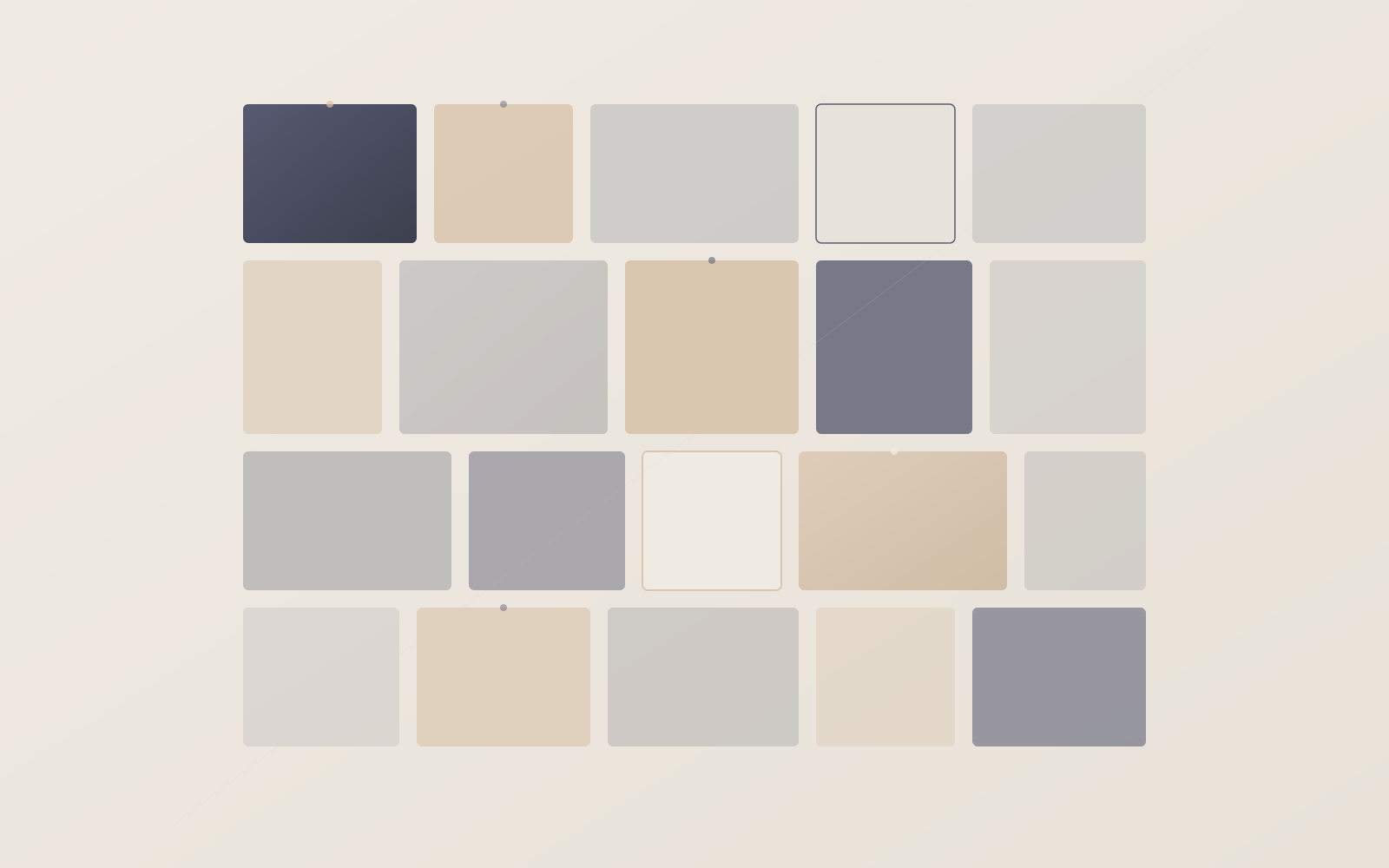
Arrange with intention. The placement of elements on a board communicates hierarchy. The dominant image -- usually placed at center or top -- establishes the primary mood. Supporting images radiate outward. Material swatches cluster together to suggest a palette. White space between groupings creates breathing room and signals that these are distinct-but-related ideas, not a visual pile. Arrangement is not decoration. It is communication.
Choosing Images, Materials, and Textures
The selection process is where most mood boards succeed or fail. Here is what separates a board that generates useful direction from one that generates confusion.
Choose images for their specificity, not their beauty. An image of a beautiful room tells you very little unless you can identify exactly which quality you are borrowing from it. Is it the way the light enters? The proportion of the furniture to the room? The specific shade of the plaster? Pin the image and annotate it. "This -- but only the floor tone" is infinitely more useful than "I like this."
Physical material samples are non-negotiable. Digital images cannot convey how a material feels under your hand, how it catches light at different angles, or how it ages. Whenever possible, obtain physical swatches of fabric, stone, wood, and metal. Lay them together. Notice how they interact. A marble that looks cool and elegant on screen may read warm and buttery when placed beside a swatch of oatmeal linen. These interactions are invisible on screen and essential in reality.
Pay attention to what you keep rejecting. The things you remove from a mood board are as informative as the things you keep. If you keep pulling images of warm wood tones and keep rejecting cool grays, that pattern is data. If you are drawn to rooms with abundant natural light and resistant to moody, dark-walled spaces, that pattern is data. Your rejection instinct is refining your vision in real time. Honor it.
Translating a Mood Board Into a Real Space
A mood board is a promise. The room is the delivery. The gap between the two is where many projects lose their way. Here is how to bridge it.
Extract principles, not prescriptions. A mood board image of a kitchen with brass hardware does not mean you must use that exact hardware. It means you have identified warmth, metallic accent, and perhaps a vintage sensibility as principles. There may be dozens of hardware options that serve those principles. The mood board gives you criteria for choosing, not a shopping list.
Test materials in the actual space. A fabric that looked perfect on the mood board may behave differently in the actual room, where the light is cooler, the ceiling is lower, or the adjacent wall color shifts the perception. Always bring your material selections into the space and observe them at different times of day before committing. This step is not optional. It is the step that separates professional results from amateur approximations.
Return to the board at every decision point. When you are choosing between two light fixtures, two paint colors, or two rug sizes, place each option mentally -- or physically -- alongside the mood board. One will resonate. One will not. The board does not make the decision for you, but it does make the right decision obvious.
Digital Versus Physical Boards
Both have their place, and the best practice is often to use both.
Digital boards -- built in tools like Pinterest, Milanote, or Adobe Express -- are excellent for collection, iteration, and sharing. They are easy to rearrange, and they allow for rapid experimentation. Their weakness is flatness. Everything on a screen is the same texture, the same temperature, the same weight. You lose the sensory dimension entirely.
Physical boards -- assembled on foam core, pinned to a wall, or laid out on a table -- restore that dimension. They allow you to place a swatch of raw silk beside a chip of honed limestone and feel the conversation between them. They occupy space, which means they demand attention in a way that a browser tab does not. For final presentations and critical decision-making moments, physical boards remain superior.
This intersection of process and instinct is exactly what we explore in the Mood Board Mastery Kit. It includes curated template frameworks, material sourcing guides, and the step-by-step methodology we use at TAEST Studio to build mood boards that do not just inspire -- they direct.
Because a mood board is not the beginning of a project. It is the moment the project discovers what it wants to become. Everything that follows is just the patient, disciplined work of bringing that discovery into the world.